
Technology
Time-Lapse Embryoscope
Continuous embryo monitoring without removing them from the incubator.
ICSI · Gurugram
Intracytoplasmic Sperm Injection: a single, precisely selected sperm injected directly into the egg. The gold-standard answer to severe male factor infertility.

Cycle duration
4–6 weeks
Sperm injected
1 per egg
Fertilisation rate
70–80%
Hospital stay
Day-care
Anaesthesia
Mild sedation
Live-birth rate
Comparable to IVF
Overview
ICSI (Intracytoplasmic Sperm Injection) is a micromanipulation technique used during IVF where a single, motile, morphologically normal sperm is injected directly into the cytoplasm of a mature egg using a fine glass needle under a high-magnification microscope.
Eligibility criteria we evaluate at the first consultation.
Oligospermia, asthenospermia, or teratospermia on semen analysis.
Sperm retrieved surgically via PESA, TESA or microTESE.
Less than 30% fertilisation in a previous IVF cycle.
When sperm motility is reduced post-thaw.
Optimises fertilisation when only few eggs are available.
Prevents extraneous sperm DNA from contaminating biopsy results.
ICSI follows the same stimulation + retrieval as IVF, with an additional micromanipulation step in the lab.
Same as IVF — daily injections to mature multiple follicles, then transvaginal egg retrieval.
Sperm sample washed and the most motile, morphologically normal sperm selected under high magnification.
Surrounding cumulus cells removed so only mature (MII) eggs are injected.
A single sperm injected directly into each mature egg using a glass micropipette under an inverted microscope.
Embryos cultured to blastocyst stage in time-lapse Embryoscope.
Single embryo transfer, fresh or frozen.
Our outcomes vs national averages.
Fertilisation rate
70–80%
Per mature egg injected
Blastulation rate
45–55%
By Day 5
Live birth < 35y
52%
Per transfer
Live birth 38–40y
26%
Per transfer
Individual outcomes vary. We provide a personalised prognosis at consultation.
Technology
Continuous embryo monitoring without removing them from the incubator.
Technology
RFID identification system that prevents specimen mix-ups across the IVF workflow.
Technology
Precision laser hatching of the zona pellucida to support implantation.
Meet your doctor
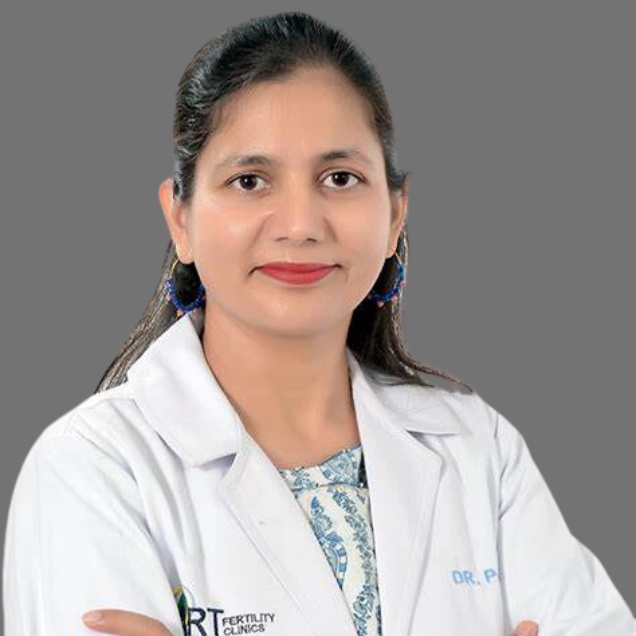
Senior IVF & Fertility Specialist · 20+ years · 5,000+ cycles
“After three failed cycles at another clinic, Dr. Parul re-investigated everything. Her protocol gave us our daughter, Aarna. She didn't just treat us — she believed in us.”
Priya & Rohan, Delhi
IVF after 7 years of trying
“We travelled from Suva. The team handled everything — visa support, accommodation, even translation. Our son arrived in November.”
Suva & Anish, Fiji
International Patient — ICSI
“I almost gave up. Dr. Parul's PCOS program changed my life — physically and emotionally. Forever grateful.”
Rahima, Dhaka
PCOS Fertility Program

Personalised In-Vitro Fertilization protocols with global success rates — designed around your fertility profile, not a template.
Preimplantation Genetic Testing — embryo selection with chromosomal precision, reducing miscarriage and improving implantation.

Compassionate, anonymous, ethically managed donor egg, donor sperm and donor embryo programs — strictly compliant with Indian ART Act 2021.
A personal consultation with Dr. Parul Katiyar costs ₹2,000 — and clarifies more than a year of Googling.
Quick enquiry